
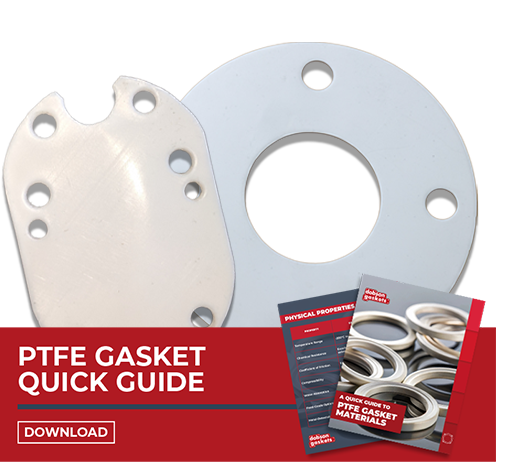
PTFE gaskets are used across chemical processing, oil and gas, food production and general industrial systems where sealing performance must be maintained in aggressive environments. Known for their chemical inertness, wide temperature capability and low friction, PTFE materials are often specified where elastomers or fibre-based gaskets would degrade.
However, PTFE is not a single material specification. Variants including virgin PTFE, filled PTFE, and expanded PTFE (ePTFE) exhibit fundamentally different mechanical behaviours. Properties such as creep resistance, compressibility, load retention and flange adaptability vary significantly between types.
For reliable sealing, PTFE selection must be based on application conditions rather than default material choice. Dobson Gaskets supports this process by working at a compound and application level, ensuring the selected PTFE variant aligns with operating pressure, temperature, media and flange condition.

Near-universal chemical resistance and stability across a wide temperature range. It is best suited to aggressive media where mechanical loads are relatively low, as it is prone to creep under sustained compression.

Incorporates reinforcing materials such as glass, carbon or graphite to improve strength, wear resistance and dimensional stability. It performs more reliably under higher loads and pressures, although chemical compatibility becomes dependent on the filler used.

ePTFE is mechanically structured rather than chemically modified. Its fibrillated matrix allows it to compress and conform to flange irregularities, making it particularly effective in low bolt load conditions or on damaged sealing surfaces, while retaining the chemical resistance of virgin PTFE.

Surface-treated to enable bonding to other materials. While its bulk properties remain consistent with PTFE, it is used where adhesion is required in composite gaskets or lined components.
The differences between PTFE gasket materials are most evident under load, over time and in real application conditions. Virgin PTFE offers near-universal chemical resistance but exhibits high creep, making it less suitable for sustained load or high-pressure environments. Filled PTFE improves mechanical strength and reduces creep, enabling better performance under higher loads, although chemical compatibility depends on the filler used. Expanded PTFE behaves differently, using its fibrillated structure to conform and seal at low bolt loads while maintaining resistance to further deformation. This makes it particularly effective on imperfect or damaged flanges. Etched PTFE does not alter sealing performance but enables bonding in composite or lined gasket designs.
While temperature capability is similar across PTFE types, performance is ultimately defined by the balance between creep resistance, load conditions and chemical exposure.
| Performance Property | Virgin PTFE | Filled PTFE | Expanded PTFE (ePTFE) |
|---|---|---|---|
| Temperature Resistance | Excellent | Excellent | Excellent |
| Pressure Capability | Low to moderate | High | Low to moderate |
| Creep Resistance | Poor | Good to excellent | Good |
| Compressibility | High | Low to moderate | High |
| Bolt Load Retention | Poor | Good to excellent | Good |
| Chemical Resistance | Near-universal | Good but filler-dependent limitations | Near-universal |
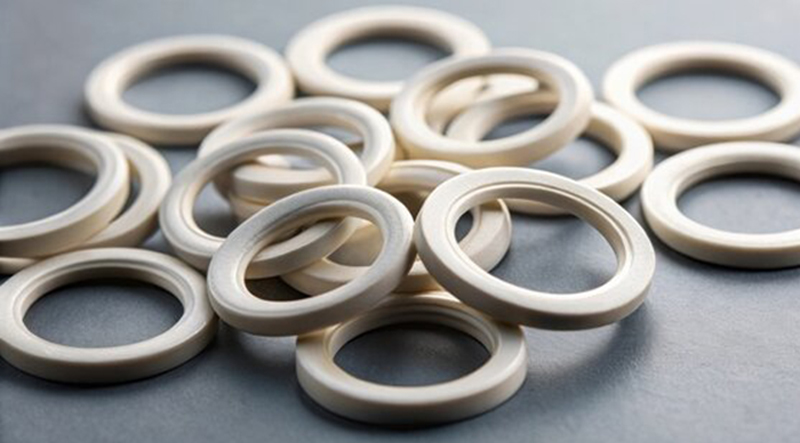
PTFE gaskets are most commonly used in sectors where chemical resistance and sealing reliability are critical, including chemical processing, oil and gas, pharmaceuticals, food and beverage, and water treatment. Typical applications include pipe flanges, valves, pumps and vessel sealing in systems handling corrosive fluids, solvents, steam and mixed media. Expanded PTFE is often specified for large-diameter or low-load flanges, while filled PTFE is used in higher-pressure mechanical systems. Across these sectors, PTFE is selected where conventional gasket materials would degrade, contaminate the process, or fail to maintain long-term sealing performance.
Our highly experienced technicians can advise you on the best sheet materials and manufacturing processes for a wide range of gasket applications.
We supply a vast range of gasket materials, available to buy directly or order from us. For more information visit the Gasket Sheet Materials page